
A new sales channel
Add your own digital ordering route to your existing sales channels. Your shop can make products and advice available beyond a personal conversation.
Turn your products into a clear shopping experience
We develop a shop where customers can understand your products and order easily. From the initial product structure through payment, delivery and upkeep, we consider the entire process, including on smartphones.
Free initial consultation · Your personal contact
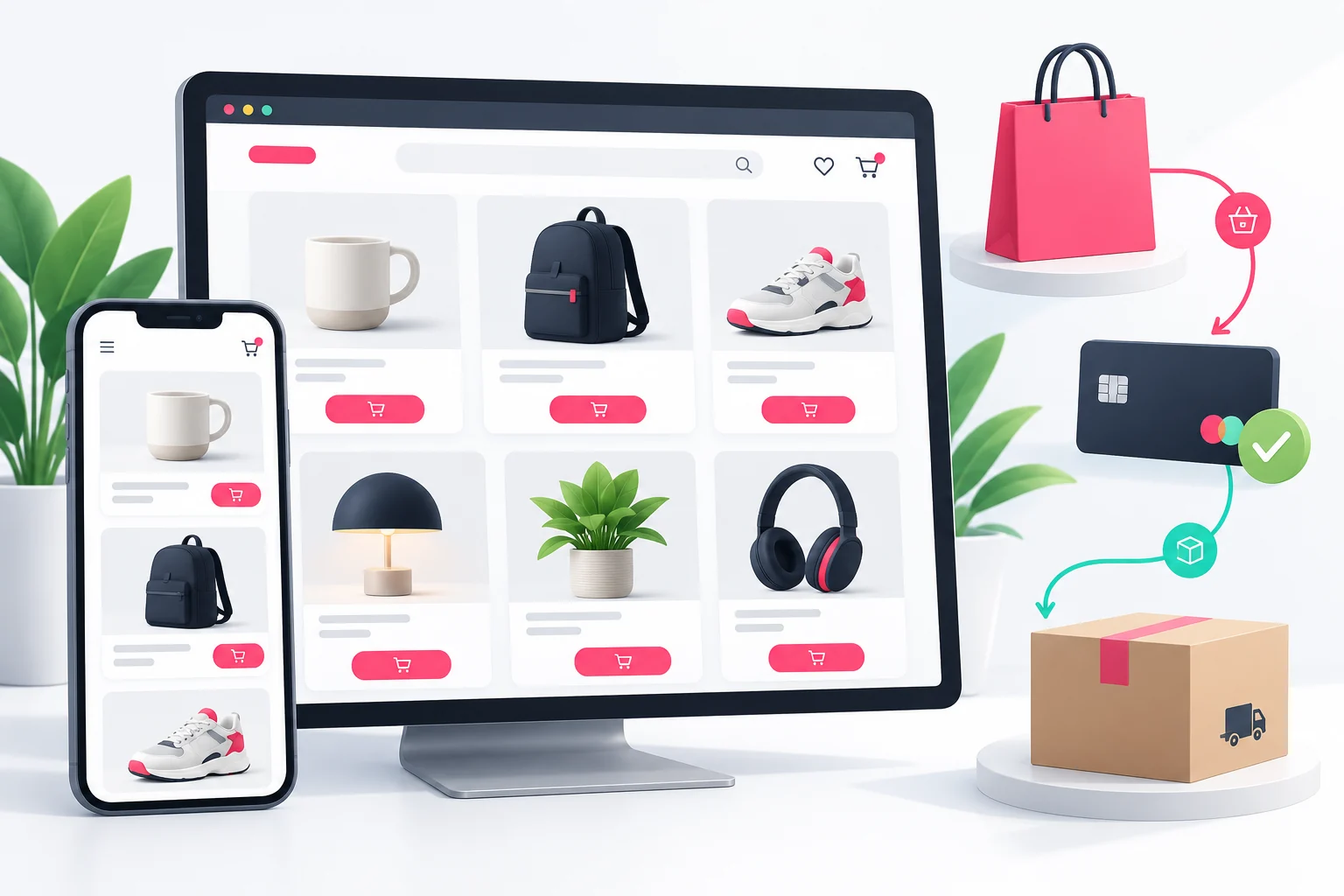
Online shops explained simply
Customers want to know whether a product suits them, what it costs in total and how it will reach them. At the same time, you need to process orders, monitor stock and answer questions. These two sides belong together: a good shopping experience for your customers and a manageable process for your business.
That is why we do not start by asking which shop template looks best. We want to understand what you sell, how your products need to be explained and how your business operates today. On that basis, we plan the design, features and possible integrations. This might be a manageable first shop or the further development of an existing system.
01 · Understand the business model first
Not every online shop needs the same features. A local delicatessen offering selected gift packages has different requirements from a manufacturer with many variants or a retailer with an existing inventory management system. We clarify the product range, audience, delivery area and post-purchase tasks before recommending a technical solution.
A sensible launch can be deliberately limited: your most important products, a clear delivery area and a few well-managed payment methods. Additional features such as collection, digital products, individual price groups or special order approvals are included where they provide real value. The result is a shop whose scope fits your business.
Add your own digital ordering route to your existing sales channels. Your shop can make products and advice available beyond a personal conversation.
Recurring questions about variants, availability and ordering can be handled in a structured way. This requires accurate product data and clear internal responsibilities.
If customers struggle to find products or administration involves a lot of manual work, a targeted revision can be more helpful than rebuilding everything.
02 · Your product page provides advice
A product photo alone rarely answers every question. Which size is right? What material is the item made from? What is included? How do two similar variants differ? We help organise this information sensibly. Good product data makes purchasing easier and can reduce unnecessary questions.
This includes a clear category structure, suitable attributes and images that genuinely show the product. Filters are useful when they match your customers' questions. For a small range, a simple overview can work better than lots of empty options. Large ranges require correspondingly more attention to search and data maintenance.
03 · Easy to use with your thumb
People shopping on a mobile often have less space and less patience for awkward controls. Product images need to be presented appropriately, text must remain readable and variants easy to select. Customers should be able to check their basket without important information disappearing behind tiny buttons.
We therefore consider the entire mobile purchasing journey: finding a product, choosing variants, adding it to the basket and completing the order. Error messages, input fields and returning from the payment provider are part of this too. The layout adapts to smartphones, tablets and desktops; essential product information must not simply disappear.
Try the shop demo
Desktop: a wide product grid displays several items side by side. Product information and the basket remain easy to find.
04 · Clarity at the crucial moment
Checkout is the transition from interest to an order. Customers should understand which products are in their basket, which delivery options are available and what costs apply. Unnecessary inputs and unclear feedback make this harder. We therefore plan the process around your offering and your buyers' needs.
Payment methods and delivery rules are not set up in isolation. A heavy product may need different shipping conditions from a small accessory. Local collection requires different information from parcel delivery. Payment providers also require their own accounts, approvals and agreements. We discuss these requirements and technically integrate the agreed options.
The process continues after clicking “Order”: the order confirmation, payment status, dispatch processing and any cancellation or question must be clear. Before launch, we test the agreed standard cases and important error scenarios. Legal texts, price information and tax requirements are technically implemented according to the requirements you provide or have professionally reviewed.
Your customers' journey
Understand the offering and its benefits.
Select the variant, quantity and details.
Work through the basket and checkout.
Receive confirmation and the next steps.
Together, we choose suitable options and check the technical process. Fees, terms and availability depend on the payment provider.
Delivery areas, shipping costs and collection information are set up to suit your business and checked with different baskets.
You need a clear view of new orders, payment statuses and the next task. Responsibilities are clarified early on.
05 · Technology follows your requirements
No shop platform is automatically best for every business. WooCommerce adds shop features to a WordPress website and can run on suitable hosting of your own. This offers considerable design freedom but also requires clear responsibility for hosting, updates and extensions. Any additional features required affect the effort and ongoing costs.
Shopify combines many technical operating tasks in a hosted platform. This can make getting started and administration easier. However, the provider's features, plans and interfaces apply. Additional apps and payment processes may bring further costs. Even with a hosted solution, it is important to check which data and features can be taken with you if you switch later.
Custom development can be useful when existing systems cannot adequately support special processes. However, it requires appropriately planned development and maintenance effort. We compare the options against your requirements and explain the consequences clearly. Using a familiar system at any cost makes as little sense as an unnecessarily large custom solution.
Connected processes instead of isolated tools
Text, images and variants.
Suitable payment methods.
Delivery routes and conditions.
Availability and stock levels.
06 · Less duplicate work
Many businesses already maintain product data, inventory or invoices in other programs. If the online shop needs the same information again, a lot of manual work can result. An interface is a technical connection through which systems exchange agreed data. Whether and how this is possible depends on the existing software and access options.
We therefore first check which system should be the reliable source for each piece of information. Does stock come from inventory management or is it maintained in the shop? Which orders must be transferred? What happens if a connection temporarily fails? Good integration also means answering these questions and making errors clearly visible.

07 · Good content for relevant searches
A shop needs more than good product data for administration: it needs clear content for people and search engines. This includes meaningful page titles, organised navigation, suitable category introductions and individual information for important products. Simply distributing manufacturer descriptions across many pages does not replace explanations tailored to your customers.
We provide a sound technical foundation and discuss which content should be available before launch. Further search engine optimisation or paid campaigns can then be planned separately. First, the shop itself should be able to present the advertised products clearly.
08 · Launch is an important step
A published shop still needs ongoing attention. Products change, extensions receive updates and customers may have questions. For a self-hosted solution, backups and technical maintenance are part of this planning. With a platform, tasks such as data maintenance, app administration and checking your purchasing processes still remain.
Total costs therefore comprise several parts: planning, design and setup, product data, necessary integrations and ongoing platform, hosting or licence costs. Payment provider fees and other operational tasks may also apply. We present the items relevant to your project clearly and distinguish one-off from recurring costs.
If a shop already exists, we plan the transfer of suitable product data and images and how to handle previous page addresses. An export is not automatically a complete copy of every feature. Before switching, we therefore check what can be transferred, which data needs cleaning and how the new process will be tested before launch.
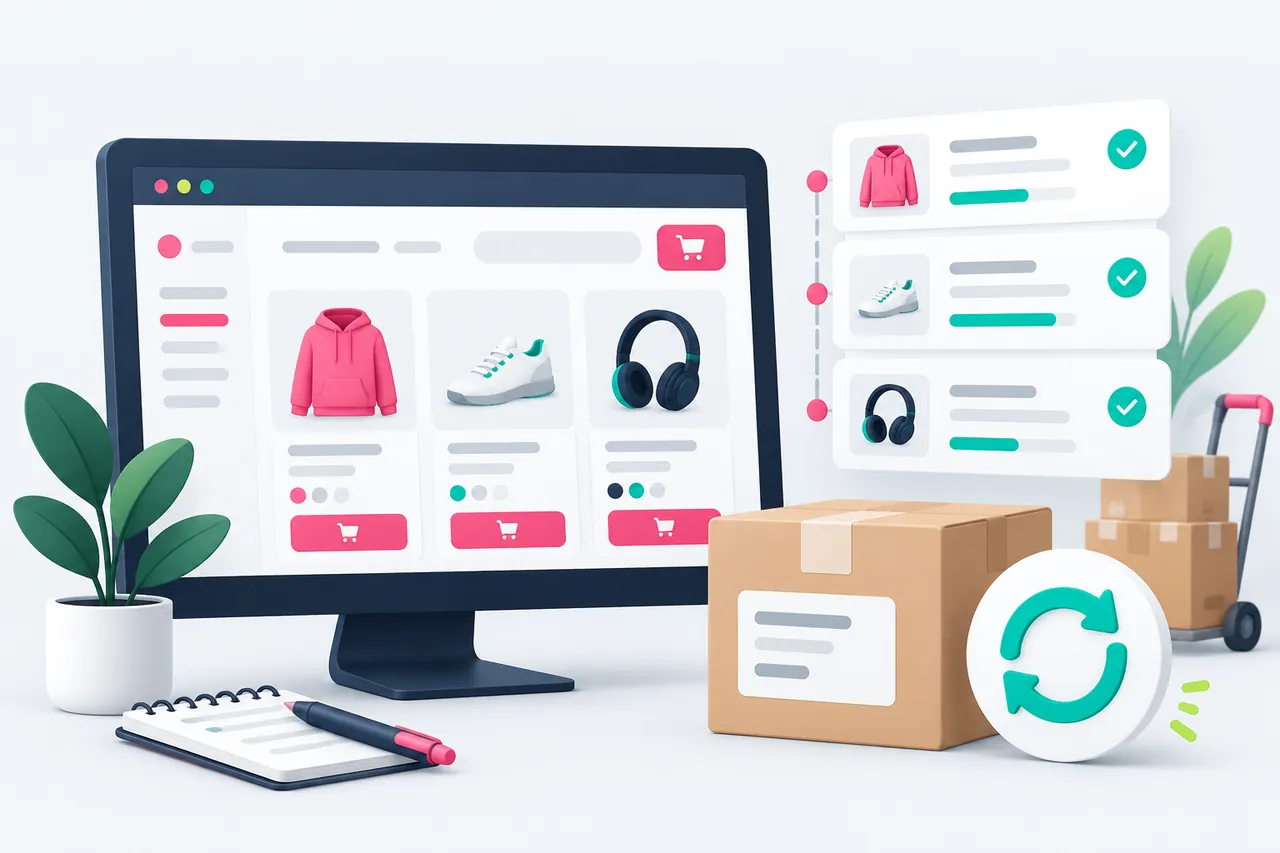
From idea to implementation
A clear process, straightforward agreements and results you can help shape.
We discuss your products, audience, delivery areas and existing software. This identifies the features needed for a sensible first version of your shop.
We compare suitable solutions, structure product data and clearly define the design, payment methods, shipping rules and possible integrations.
We implement the agreed scope and use suitable test cases to check mobile presentation, variants, baskets, payment and order processing.
Following approval, the shop goes live. You receive a clear introduction, and we discuss responsibilities for maintenance, updates and any further support.
Good to know
This is possible with suitable shop administration. We clarify in advance which tasks you want to handle yourself and set up the agreed editing options. For extensive ranges, data imports or a connection to an existing system can also be useful.
The recommendation depends on your range, features, internal processes and ongoing workload. WooCommerce, Shopify and a custom solution have different strengths and responsibilities. We explain these differences in the context of your particular project before a decision is made.
We discuss suitable options for your audience and the technical requirements. The methods available depend on factors including the chosen system, payment provider, your offering and its approval. Fees and contracts are considered separately from our implementation.
We first check its technical condition, access details and existing data. Sometimes a targeted improvement is enough. If you switch, portability, page addresses, orders and future workflows are considered individually. A fully automatic migration cannot be promised before this review.
A small, clearly explained range can be a sensible starting point. What matters is that demand, product presentation and order processing fit together. We can assess together whether a shop, an order enquiry or initially a clear product presentation would suit your business best.
Ongoing support can be agreed by arrangement. We define whether you need help with technical updates, content changes, functional checks or further development. Recurring services and costs are described in the proposal or a separate agreement.
Useful additions

Your website should explain what you offer, build trust and make the next step easy. We design and develop a website with your customers in mind, on smartphones and larger screens alike.
Learn more ↗
We combine search engine optimisation, targeted advertising and clear content for AI search. With one clear goal: drawing the right people's attention to your offering.
Learn more ↗
New opening hours, a necessary update or a form that no longer works: with suitable website support, you have a contact for ongoing technical tasks and changes.
Learn more ↗Let's get to know your plans
Tell us what you sell and how your business operates. We will clearly explain which solution fits your launch and which additions could be useful later.
← Back to all services